Category Archives: Knaphill Community

15 High Street already causing problems

Pandemonium has descended on Knaphill High Street as the first full day of construction begins at the old Cliftons site.

As noted by Phil Stubbs,

Five large trucks arrived in the village with the objective of removing earth from the Clifton’s site. Given the size of the site only one truck could actually enter the grounds and the other four trucks were parked in the High Street. One truck was parked half on the pavement and half on the road outside 22 High Street (Take Away), the second truck was parked on the zigzag lines at the pedestrial crossing outside Barclays and the third and fourth truck were taking up the whole of the bus lay-by outside Anchor Crescent.

Despite being reported to the police on their 101 number, only the truck on the zig zags was of concern to them and the others were a civil matter. Strictly this is true but it’s pretty obvious that they’re all part and parcel of the same issue so in my opinion this is a very blinkered view to take. That said, a car was to be despatched as one became available.

This is the first full day of construction and the Council plus the police have to firmly lay down the ground rules. Will they?

UPDATE from Phil 9.30am

I have just taken a call from Surrey Police, they have visited High Street and after talking to the site manager the police have agreed that one truck can wait in the bus lay-by but that there should be no other trucks on the High Street. The reason for allowing one truck is that the police were informed that it will only takes 10 to 15 minutes to load a truck and they want to complete the task as soon as possible. The contractor has been told that if they do not stick to the instructions given to them this morning they will be booked.

Watch this space?

Update 8/3/1315 High street construction

Well we didn’t have to wait long! Furious residents have complained to WBC and councillors about the contracting company’s blatant disregard for residents and the practicalities and legalities of getting large vehicles to the site. This has been exacerbated by doing so in rush hour traffic.

There’s a picture (awaiting permissions) as a good example – of a lorry reversing into the site on the pedestrian crossing, with a bus trying to pass, and an HGV waiting in the opposite lay-by. As has been pointed out – is this the future of all deliveries given the arrangements approved by the planning committee?

No improvement for traffic until after 2020?

At a meeting of Surrey County Councils Local Committee on the 06 March a paper was presented by Surrey Highways Authority on the congestion around the Brookwood Crossroads and adjoining roads. It is a pity that this debate was not held before the Planning Committee had to vote on the development on Brookwood Farm.

In presenting their paper SCC stated that as the major work programme from now until 2019 had been agreed they recommended that the congestion on the A322 should be considered as part of the review of major road schemes in 2015 for the post 2019 programme. This means that any major scheme designed to reduce the congestion on the Bagshot Road would not commence until 2020 at the earliest. This would be 3 years after the completion of all the new houses on Brookwood Farm and the opening of the new school.

The plan from SCC was vigorously challenged by the KRA, Brookwood Residents Association and the majority of Councillors who spoke during the debate. Cllr. J. Kingsbury put forward a suggestion that the in-depth study of the A322 and surrounding roads should start this spring. The study will take 18 months to complete and cost £50,000. Officers from Surrey Highways took the request away and will respond in the coming weeks.

One suggestion in the paper presented by Surrey Highways was that for short journey’s that is a journey of up 5 miles residents should consider walking or cycling rather than using a car. Phil Stubbs asked if this meant a parent living in Knaphill with a child attending the school in Bisley should walk or cycle the journey Knaphill/Bisley four times a day. Or the Brookwood resident from Brookwood going shopping at Sainsbury’s should take their bike rather than the car.

Peer Productions have their pants on fire!

‘Pants On Fire’ & ‘Mobile Phone Show’

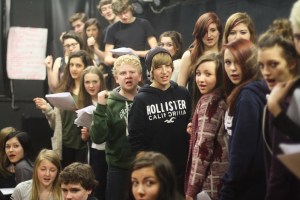
Award-winning Peer Productions are back with two new youth theatre shows which will charm, delight and make you reconsider your belief in mobile phones and cupcakes. Woking’s biggest youth theatre are excited to bring to you Jim Cartwright’s ‘Mobile Phone Show’ and ‘Pants on Fire’ by Nina Lemon in an epic double-bill at the Rhoda McGaw Theatre, Woking from 14th – 16th March.

Young Jennifer June’s world is turned upside down as she begins to “ditch the truth and improvise with teeny weeny little white lies” in the unconventional cautionary tale, ‘Pants On Fire’. This charming musical performed by the Junior Youth Theatre will have your hearts melted, your spirits lifted, and your suspicion of cupcakes indefinitely raised.Peer Productions

Then join the Senior Youth Theatre for Jim Cartwright’s (The Rise and Fall of Little Voice, Road) ‘Mobile Phone Show’, part of National Theatre Connections, as we gain an insight into how technology has changed the lives of young people. Is it confining our communication? Or is it a tool to evolve our creativity? Is true love destroyed by mobile phones? And what if there were an app to mend a broken heart? Sit back and enjoy the spellbindingly complex production pull your imagination in ways you’ll never expect.

Co-Artistic Director of Peer Productions Nina Lemon said “Peer Productions Youth Theatre have pulled together to create two incredible shows and I am proud of all their efforts. I am confident that this will be a spectacle to behold and a great evening out for all ages. And as always, I’m blown away by what the young people can achieve.”
Performances take place at 7pm on 14th, 15th and 16th March at the Rhoda McGaw Theatre in Woking. Tickets are £12/ £10 concessions with a special discount of £7 for all those under 19 years old. Tickets are available from www.ticketsource.co.uk/peerproductions or by calling 01483 476825.

Editors note –

If you haven’t been to one of Peer Productions performances before then make the time – the last one I saw was excellent, very much a top class performance


Ground clearance at Almond Villas

Walking through the village today I have noticed ground clearance work at the Almond Villas site in Broadway.

Although outline planning permission was given a while back, no definite plans have been seen or made available and it was our understanding that such a development would require detailed information to be presented. See our old posting here https://knaphill.org/2012/02/almond-villas-site/

Curiously, there is still a For Sale sign up but maybe the trust who own / owned the land are jumping the gun a bit in preparation.

We’ve contacted Jenny Jackson at the planning dept at WBC for a bit more information and will update as soon as possible.

Community Infrastructure Levy (CIL)

I’ve just received an email from WBC for a consultation on the Community Infrastructure Levy (CIL) that I would encourage residents to look at. The site for the information on the CIL is here – http://www.woking2027.info/infrastructure

and WBC information page is here – http://www.woking.gov.uk/planning/policy/ldf/cil

The letter is as follows –

Dear Sir or Madam,

CIL Preliminary Draft Charging Schedule Woking Borough Council has decided to adopt Community Infrastructure Levy (CIL) as its primary means for securing developer contributions towards infrastructure provision in the Borough. CIL is a standardised levy that is charged to new development for the purposes of raising funds to deliver infrastructure to support new development. The provision of infrastructure has implications for people who live and work in and visit the Borough. In this regard, the Council values your involvement to ensure that the rates set for the Charging Schedule are set at the right level.

A key stage towards the adoption of CIL is the publication of a Preliminary Draft Charging Schedule for consultation. Your views are therefore being sought on all aspects of the Preliminary Draft Charging Schedule to enable the Council decide whether the rates are set at reasonable levels.

The consultation period is between 15 February and 2 April 2013 and you are encouraged to send any representations that you may have.

The Preliminary Draft Charging Schedule is available for inspection at the following venues:

Woking Borough Council, Civic Offices, Gloucester Square,Woking, GU21 6YL. Monday to Friday 9am – 4.45pm.
Woking, Byfleet,West Byfleet and Knaphill libraries. Please see www.surreycc.gov.uk for address and opening times of the libraries.
On the Council’s website www.woking.gov.uk

Comments can be e-mailed to planning.policy@woking.gov.uk or posted to: The Planning Policy Team Woking Borough Council Civic Offices Gloucester Square GU21 6YL

If you have any questions on the Preliminary Draft Charging Schedule, please do not hesitate to contact a member of the Planning Policy Team on 01483 743871.

The Council has also published a number of documents that has been used as evidence to inform the Preliminary Draft Charging Schedule. This includes:

· Community Infrastructure Levy Viability Study;
· Community Infrastructure Levy – Topic Paper on Infrastructure Funding Gap;
· Map illustrating where differential charging rates will apply; and
· Strategic Environmental Assessment – Draft Screening Statement.

Copies of these documents can also be inspected at the deposit venues set out above and on the Council’s website.

Next stages of the adoption process
Your comments on the Preliminary Draft Charging Schedule will be analysed and taken into account in preparing a Draft Charging Schedule. There will be a further opportunity for you to comment on the Draft Charging  Schedule before it is submitted to the Secretary of State for Examination.

Comments received at this stage together with the Draft Charging Schedule will be submitted for Independent Examination sometime at the beginning of 2014. Subject to the recommendations of the Inspector, it is anticipated that the Charging Schedule will be adopted by April 2014.

It is important to note that until CIL is adopted, the Council will continue to use Planning  Obligations to secure developer contributions.
Yours sincerely,
Ernest Amoako
Planning Policy Manager
For further information please contact Ernest Amoako on 01483 743427 (Direct Line) or
Email ernest.amoako@woking.gov.uk
CIL Preliminary Draft Charging Schedule Letter


Brookwood Farm update

The majority of you will know that on the 29th January the Councillors who make up the Planning Committee approved the application from Cala Homes to build 297 dwellings on the land at Brookwood Farm. I came away from the meeting both angry and disappointed.

Angry because the Council Officers totally ignored those people who current live around Sparvell Road, Oak Tree Road and Coresbrook Way. It is these residents who will suffer the most from the increased traffic, its related noise and air pollution.

All the Councillors who spoke during the debate expressed reservations with the data included in the Planning Officers report on traffic levels. Although there was unanimity amongst the Councillors for a deferment once the Deputy Chief Executive, Head of Legal Services and Head of Planning applied verbal pressure on the Councillors not to vote for a deferment and accept the plan the majority caved in. All those Councillors not directly connected with Knaphill or Brookwood fell under the pressure and voted against a deferral and for the plan.

So yes disappointed with the fact that the Councillors did not stand by the views they expressed when they spoke for a deferment.

Why was so much pressure exerted on the Councillors? I believe there were two main reasons, first the Council have set themselves a target of 4,964 new dwellings between 2010 and 2027 (an annual average of 292 per annum). Secondly money, around two thirds of the land to be developed is owned by Woking Borough Council and that will now be sold to Cala Homes. That money will go to pay off a loan that the Council took out to pay for the work that was carried out in the Hoe Valley close to the Leisure Centre and Westfield Avenue.

Why were Councillors seeking a deferment? The Planning Officers report, the main document that is being debated and voted on, is only produced a week prior to the meeting and therefore there is not a lot of time to take on board all the detail that goes into a major development like Brookwood Farm. Let me put into context, in the past the Planning Committee deferred to a second meeting the applications to develop the Clifton’s site in the centre of the village and the extension to Sainsbury’s in Redding Way. Brookwood Farm is a much bigger development than either of the above and therefore why was the Deputy Chief Executive so opposed to the Councillors deferring a decision until they fully understood the proposal that the Planning Department and Surrey Highways were putting forward? That is a question for Woking Council to answer.

Unless a Councillor has been following the debate since the application was submitted last April then they rely on the Planning Officers report being accurate and objectively cover all aspects of the application. This report failed to achieve that objective.

For example The Planning Officers report states that there will only be a 33% increase in traffic levels going down Sparvell Road towards Bagshot Road between todays figure and the traffic levels once the development is completed. In words of the County’s Road Planning Manager an average of one additional vehicle per minute during peak times. Compare that with the figures in the Transport Assessment, a report produced by consultants as part of the preparation for the production of the Planning Officer’s report. The Transport Assessment shows an increase of 127% in the morning peak and 133% in the evening peak. The Councillors, and ourselves, wanted a deferment so that those differences could be investigated.

Another example of where the Planning Officers got it wrong. With reference to the length of the queuing traffic from the Brookwood traffic lights back up the Bagshot Road. The report states;-

‘The applicant’s Transport Assessment acknowledges that Bagshot Road is already heavily trafficked and that queuing develops, particularly at Brookwood Crossroad during peak hours to the extent that occasionally, southbound queue at the crossroads block the Redding Way signal.’

What a complete understatement, the queue is regularly beyond The Broadway never mind Redding Way.

There is a legal requirement that where a developer wants to build close to a heavily congested road they have to make recommendations on changes that will not significantly add to that congestion. In April 2012 I along with other representatives of local residents associations plus a number of Councillors met with Iain Reeve, Assistant Director Strategy, Transport & Planning and Greg Devine, Road Planning Manager both from Surrey County Council. We asked whether they believed the traffic management plan proposed by Cala Homes would somehow mean that the additional traffic would not add to the congestion. The response was that the proposed changes to the traffic light systems were unproven and that in their opinion would not meet the expectations of the developer. So what has changed between April 2012 and January 2013? As far as I know Cala Homes have not changed their proposed modification to the traffic lights systems. Maybe the KRA should invite Mr Reeve to another meeting so he can explain the change in the position of his department.

People have been asking where can we go from here. We the residents do not have the right of appeal. The only people who have the right of appeal to a decision made by the Planning Committee are those who submit the application. So if the Councillors on the Planning Committee had rejected Cala’s application Cala Homes could appeal and that would have gone to a Planning Inspector and probably a public inquiry. I cannot see how, following a public inquiry a Planning Inspector could have come up with a worse result than the one we got on the 29th.

This does not mean that the KRA will give up the fight, we have already asked Woking’s Head of Planning to explain the difference in figures for traffic in Sparvell Road.

We will keep you informed of any information that we are able to obtain.

The State of Planning

The plans for Brookwood Farm have been passed. Rightly or wrongly many residents feel abused by ‘the system’ and feel that the council has not performed their duties as well as they should have. This article is more of a collection of thoughts than a narrative of failings so any official reading through should not take overt offence but do feel free to leave comment.

Housing targets

We all know the government has set planning targets for each and every council in the land; these targets have to be met which requires new homes to be built. In the south east the demands are great – it’s a desireable place to live and housing costs are high but the landscape is pretty built up already. What green space there is is normally hard to get permission for building on and decent sized brownfield sites are hard to come by. People may disagree with the targets set both by government and borough councils but they are here to remain. There is a whole other argument as to the rationale behind the targets but that is for another time and place.

Where to build?

This is one of the key questions; the crux of the matter really. Building a huge number of homes piecemeal is not cost effective and will not make up the numbers adequately. To build in numbers you either build flats upwards or you build houses outwards and it’s the latter that really grabs the landscape. This is why whenever you see new proposals there are usually a number of flats thrown in – it sweetens the deal by making up numbers that the council need desperately.

So what of locations and where to build? Woking is simply short of them and that is why plans such as those for Brookwood are passed. There is no single place where a lot of houses can be built and not upset the residents, and I believe the residents understand, although maybe not agree with, that.

Soon to be up is Moor Lane and I guarantee a similar situation is occurring as we in Knaphill have experienced. A similar situation was shown on BBC’s ‘The Planners’ on 30th January – large swathes of land given over to developers.

Many people mention money in respect of these developments. It’s true that the councils will make money, or at least in the case of Brookwood Farm they will but not being an accountant I can’t comment on huge debt versus submitted plans.

Planning capability

Understanding of planning regulations and the local differences up and down the country is a thankless job. No-one loves a council planner but they deal with what they’re told to deal with and do so with what they’re told to use. Recently, Woking Borough Council were recruiting a proportionately large number of staff, to my mind something resembling the whole department in number. Whether this had any bearing on the Brookwood decision is anyone’s guess but it won’t have helped and the reasons for needing so many new planning office staff at once raised a few eyebrows.

The biggest wonder is exactly what the procedures the council follow actually state as the documents appear not to allow for any amount of community or residential response to be taken into account. WBCs housing strategy 2011-2016 has a couple of stated aims of creating a strong community spirit… and a clean, healthy and safe environment. The planning process abjectly fails to do this and seems to act against it.

How can the planning process help build community when the process itself does not engage with the community as a part of the plan? Speaking of my own experience of dealing with the Brookwood plans – from conception the developer had 3 meetings with the public (only 1 of 3 were widely publicised); at these there were no actual plans to discuss, only concepts. The staff were provided by the developer and had no understanding of the area, demographic or planning in general. In fact the most useful and knowledgable member there was the landscaper! From the point of plans being submitted (i.e. when the planning process kicked in) it was statements all the way from WBC; letters announcing plans had been receieved, amended and finally going to the committee. Documents found online did not appear to give the entire view and some key documents were witheld from the public prior to the committee meeting, ‘awaiting decomposition’. Although the last letter from WBC invited everyone to speak, in fact only ONE person is allowed to have their say (presumably on everyones behalf) for a maximum 3 minutes. Hardly enough time to cough and say hello. The point here is that there is no real intent at community engagement, only getting the plans through the process. Mentions of ‘community’ have been just that, mentions and nothing of substance.

With regard to Brookwood Farm, major concerns remain with regard to traffic, roads, school places and medical cover provision. Houses must be built, but the infrastructure supporting them must be an imperitive also and no-one can see where this has been met. Records from a few years ago stated the maximum number of houses supportable on the A322 was 200, not the 300 now passed by committee. A new school being built adds to the problems in several ways, firstly it doesn’t provide enough spaces for pupils but it also necessitated another entrance to the development and even more traffic movements. Figures stated were predicted. We went and did our own number checking by actually counting the traffic movements and the predicted numbers are way off.

Being practical

The point above is that a more practical approach is required. Using untested traffic models and saying ‘we must have the houses’ is not good enough. If communities are to be built, as the council purport to be adamant about, then effort is required and a little bit of legwork wouldn’t go amiss either. If a lot of people are practically shouting ‘there is a traffic problem!’ then the chances are that there is a traffic problem, it’s not a trick. Go and count some cars. Get cold, get hot and get stuck in the fumes but make damned sure your numbers are fact-based and not pie in the sky. If the number of cars don’t stack up then do something about it – reduce the number of dwellings or find another way of reducing traffic. Telling people to walk or get the bus is not one of these. The planners, the councillors and the council all know there are issues when large scale plans are up for debate but precious little is done to allay their fears.

300 new homes and a school are to be built, so what about medical cover? What’s it like at the moment? Over-burdened? Well perhaps some form of mitigation there would be in order then; make it a part of the plans (not a condition, an actual part of the plan).

What of other plans submitted? 15 High Street (with flats above) is a good one. Does a village require 3 supermarkets in close proximity? Like a hole in the head. Common sense (not part of the planning process) would suggest that 3 huge players (Sainsbury’s, Tesco and Co-Op) in the retailing game would put local traders out of business. It is not competition, it is the death of community. A look at the plans also show that deliveries can only happen if certain parking spaces are vacant which should, surely, have raised the question of ‘is this really the best idea?’. Incidentally refuse deliveries for that development will have to be made via the kerbside, another point for questioning the plans.

The Point

There is no benefit to examining in detail any plan. The point to be made here was that the planning process is just plain wrong, for starters there is no planning involved, it’s just going through the motions.

To councils up the land –  More community engagement would go a very long way with most people and be demonstrating just a bit of thought over what the plans are showing you. Thinking of the resultant activity and impacts will inevitably lead you to a better solution. Some might call this actual planning – deliberate thought over the impact of intended changes for the betterment of an area and community. Show that you value the area you have stewardship over and the people within it, and not that you are really just after the cash reward.

A simple request goes out to all of you planners – start to think about what you’re doing and stop ticking boxes.

Last thought

Last year the taxpayer footed the £50m bill for the West Coast Main Line franchise bid going pearshaped after Sir Richard Branson questioned it. He was in a unique position of wealth and influence to do so and by that factor alone unearthed what people have known for some time – the process was wrong. Where’s Branson when you need him?

Brookwood Farm considered 29th January

The plans for development at Brookwood Farm are going to be put in front of the Planning Committee on the 29th January. It is highly likely, almost certain in fact, that these will be pushed through despite community concerns over traffic and a range of other issues that have categorically been ignored or marginalised.

There is now a requirement imposed by the LEA for a new school; the new school is designed for 210 new places but must accommodate 240 making the school unsuitable before it’s built. The school has resulted in the requirement for secondary road access via Sparvell Road, a quiet road never designed to accommodate high volumes of traffic.

It should be noted that although the requirements placed on the residential (Cala Homes) development by the LEA for a new school will result in even higher volumes of traffic, the plans for both residential and school will be treated separately. In essence this means that WBC planning can ignore any traffic analysis for a new school on the site in their consideration of the residential plans. They will then be obliged to pass plans for the school irrespective of the traffic analysis and the absolute linkage between the two proposals. It’s a ridiculous situation and frankly the thought that they have been split is specifically for this reason; if considered together as they should be (being wholly dependent upon each other) the proposals would never be passed.

As many people including us have pointed out many times, the traffic on the A322 is already at or over capacity; the junction at Redding Way/Bagshot Road cannot sustain an increase of the volume being proposed, despite what an unproven and highly questionable traffic model might claim, and that’s just for the residential development. The School will add a further predicted 182 daily arrivals and 179 departures. Presumably some people stay in school overnight. Interestingly, it has been predicted that a development of 300 dwellings will produce approximately 2/3 of the amount of traffic of the school. Some arbitrary assumptions of people walking to the school has been made to reduce the scary figures but even so the reports have stated that with the school the junction will be operating significantly over theoretical capacity.

Moving traffic outlet to further up the A322 (from Sparvell Road) is a folly as they must turn left. That is of course unless SCC are overturned on their assessment of it being unsafe to turn right? Perhaps a new roundabout will be placed there but that is pure speculation and would add to traffic disruption in it’s own right. So, in order to turn right from this exit, traffic must turn left and then right into Chobham Road, another residential street with a primary school (Knaphill Lower) and impassable at peak times due to parking and other traffic issues. Cars will either perform U-turns near Birds Grove or head all the way up and turn right through the village centre or turn left back toward the A322. MADNESS!!

Will the plans be approved? Almost certainly.

Recent traffic report can be seen here.

Bookwood bullet points


BROOKWOOD FARM – KEY PLANNING POINTS


  • THE RIGHT TO DEVELOP BROOKWOOD FARM

Brookwood Farm has been agriculture land since the 1800’s but it is not, in a legal sense, part of the Green Belt. The site is one of the safeguarded housing sites as designated in the Local Plan of 1999 and Core Strategy. The safeguarded site lies between the Urban Areas and the Green Belt.

  • THE NUMBER OF DWELLINGS

Key to the whole development is the number of dwellings being planned for Brookwood Farm. The size and shape of land available for development is limited on the east by existing housing, Coresbrook Way, to the north by Bisley Common, west Sheets Heath and south the SANG, suitable alternative natural green space.

Cala Homes always maintained that the site could accommodate 297 new dwellings whilst using one road access via Redding Way. Senior representatives of WBC have stated that by converting the current T junction at Bagshot Road/Redding Way into a full crossroads the fourth arm is safe to take vehicles from 400 dwellings on Brookwood Farm.

In the Planning Officers Report for the extension of Sainsbury’s, Redding Way (PLAN/2011/0160) there is the following words:

The recent S278 Highway Act agreement with SCC for a fourth arm on the A322/Redding Way signal junction allows for scenarios of up to 400 dwellings and their associated traffic movements entering the road network from Brookwood Farm from this point.

The key words are scenarios of up to 400 dwellings. If you build 400 one bedroomed dwellings for senior citizens then the traffic flow will be different to that if you built 400 three and four bedroomed family dwellings. A S278 Highways Act Agreement is an agreement where a highway authority may, if they are satisfied it will be of benefit to the public, enter into an agreement with any person and that agreement between the County Highways Authority and Woking Borough Council (WBC) to construct the fourth arm at the Redding Way/Bagshot Road junction.

A far more important document is a Planning Office report dated 20 June 2006 as a response to a planning application from Woking Borough Council, below is an extract from that report.

PLAN/2006/0400 OUTLINE APPLICATION FOR THE ERECTION OF A RESIDENTIAL DEVELOPMENT ON A 5.82 HECARE SITE, TO INCLUDE A MINIMUM 60% AFFORDABLE HOUSING.

This was an outline application, submitted by WBC was later withdrawn.  There are two key comments from Surrey’s Highways Authority:

SCC Highways raise the issue of the impact of likely traffic movements on the highways network. Their considerations are based on an assumed level of development at 30-50dph and indicate that the likely traffic flows from this level of development may have a significant impact. This would result in the requirement to upgrade parts of the highway outside of the site.

It was accepted that the proposed fourth junction arm could accommodate up to about 200 dwellings on the total Brookwood Farm site.

It is noted that the existing main access to the site is designed to accommodate up to 200 dwellings. However, if a greater number of dwellings were to be proposed at the Reserved Matters stage, then that issue could be adequately addressed at that stage. Developers would need to demonstrate that an access serving more than 200 dwellings (across the whole safeguarded site – not just this application site) could be secured. If this is not possible, then development would be limited to 200 dwellings (across the two sites). Similarly the acceptability (or otherwise) of using Sparvell Road as a formal access, as opposed to an emergency access, would then be able to be determined.

The above demonstrates that Cala and WBC’s plan to use a single access road at Redding Way for traffic associated with 309 dwellings was never going to be approved by the County’s Highways Authority.

  • INFRASTRUCTURE – ROADSighways Authority 

The National Planning Policy Framework and Woking’s Core Strategy state that good infrastructure is an integral part of good planning.

The planning by the developer and the local authorities to manage the impact of traffic going into and out of the proposed development site at Brookwood Farm is somewhere between poor and not existent.

Surrey County Council’s congestion strategy includes the following objectives:

  • Improve the reliability of journeys
  • Reduce delays for all transport modes on key routes and at congestion hot spots.
  • Improve the provisions of journey planning information for travel in Surrey.

Given the above strategic objectives how does the following statement made by Bellamy Roberts in the transport assessment report for Cala Homes stand.

9.23 Overall the traffic impact analysis shows that there will, inevitably be some additional delays and queuing on the signalised junctions near the site. However, the increases are small in the overall context of what is already a congested network.

Basically what Cala Homes are saying to residents of Knaphill is; sorry, if you travel along the Bagshot Road we know your journey to work is subject to queuing and delays and our new housing estate is going to add to your problems.

To mitigate against the increased pressure on the A322 the developer plans to introduce a new traffic management system that will involve linking the traffic lights at Redding Way, Connaught Road and Cemetery Pales with a queuing management system. These controls are planned to prevent queuing back from one junction to another.

How this type of queuing management system will work at a junction like Brookwood Crossroads, where all four roads carry heavy traffic loads throughout the peak travel hours, is unknown and untested.

The following points come from various replies we have received from Surrey’s Highway Authority.

  • The proposed traffic management system has not been proven.
  • SCC has reservations with Cala’s estimated traffic impacts on the A322/Redding Way and A322/A324/Cemetery Pales traffic light junctions.

Cala’s traffic modelling results showed a lot of additional traffic congestion, which did not well reflect their statements about the development traffic impact. Recently we received revised traffic modelling information and we have provided some immediate feedback, because the same problems seem to persist.

  • SCHOOLS

The second sentence in paragraph 38 of the National Planning Policy Framework is as follows: Where practical, particularly within large-scale developments, key facilities such as primary schools and local shops should be located within walking distance of most properties.

We have a proposal that meets part of the above recommendation. A new school is planned to be built for children in the age range 7 to 11. This means that for the majority of families on the new estate the nearest school for children between the ages 4 to 6 will be Knaphill Lower School. Knaphill Lower School is usually over-subscribed and children living in the centre of Knaphill are being allocated places elsewhere including Bisley.

The plan to create a two site primary school in Brookwood could mean that children of families living in the centre of Knaphill will be denied access to Knaphill Lower School.

The location of schools will lead to higher car use as first schools are outside the walking distance of 400m for many families already living in Knaphill and on large parts of the proposed new estate.

To try and hide the facts the addendum to the Transport Assessment by Bellamy Roberts believes that only an additional 5 cars will travel from Connaught Road turning left into Bagshot Road and then left into the new school during the morning rush hour.

  • TRAFFIC FLOW FIGURES

The following figures have been produced by Bellamy Roberts for Cala Homes.

The developer believes that traffic going to and from the new school will only impact on the morning peak hours. Morning peak being 0700 – 0900.

School related traffic going from Connaught Road to the new school on Brookwood Farm a total of 5 vehicles.

School related traffic coming out of Brookwood Farm truning right into Bagshot Road and then right into Connaught Road for the Lower School a total of 14 vehicles.

The estimated amount of extra traffic movements brought about by the splitting of Brookwood School during the morning peak is totally unrealistic.

  • OVERALL TRAFFIC FIGURES

Brookwood Crossroads (A322/A324 junction). This junction is already trying to operate at well about its design capacity and the developer believes that the development on Brookwood Farm will increase the traffic by 176 vehicles or 8% during the morning peak.

How can an increase of 8% of traffic at an already congested junction meet SCC’s congestion objectives?

The Redding Way junction will see morning peak traffic increase by around 14% but this figure has to be question as Cala Homes only expects the 312 dwellings to produce 93 vehicles leaving the Brookwood Farm development during the morning peak. To that 93 vehicles the developer has added 39 vehicle movements linked to the school traffic.  So if the plan was to retain the single access road at Redding Way the developer states that 132 vehicles would have expected to leave the whole development site during the morning peak. With the opening of Sparvell Road that figure is reduced to 78.

Cala’s own figures estimate an additional 209 vehicle movements on the stretch of the A322 that passes through Knaphill during the morning two hour peak travel period.

  • SPARVELL ROAD

In December Cala Homes and WBC accepted the need for a second vehicle access to Brookwood Farm. Using the proposed new school building as the reason for a second access road is a smoke screen.  Cala Homes got their traffic modelling wrong and under pressure from Surrey County Council had to rerun their figures.

It was stated earlier that back in 2006 it was recognised that a development of this size would require two vehicle access roads and back in 2006 Sparvell Road was identified as the second vehicle access road.

In 2006 Sparvell Road was identified as a second vehicle access road as and when Brookwood Farm was to be developed but no investment has been made to improve the road system around this area of Knaphill.

It is important to stress that traffic leaving Sparvell Road can only turn left and so the additional traffic will have an impact on Chobham Road and very little examination of this side of the infrastructure is included in the reports made available to members of the public.

The developer, Cala Homes, and Woking Borough Council have only been interested in the infrastructure that is directly connected to Brookwood Farm and not the impact this large development will have on the whole community.

The KRA have carried out their own traffic study at Sparvell Road and over two mornings between 07.25 and 08.30 between 69% and 79% of the traffic leaving Sparvell Road turned right into Chobham Road.

WBC and SCC are still developing their implementation programmes that are required to support the development plans included in the Core Strategy.

It is important that the draft discussion paper titled ‘Woking Borough Transport Strategy & Implementation Programme’ was made available to a select few in October 2012. This document should be made available to the public before any decisions are made on Brookwood Farm development.

  • THE ALTERNATIVE PLAN
  •  
  • All development is kept to the north of the Redding Way access road.
  • The development to include the new school and dwellings up to a maximum of 200.
  • Access from Sparvell Road into the development site is to be restricted to emergency vehicles.
  • Surrey County Council and the National Highways Agency seek to find a solution to the problems with the A322 between Knaphill and Cemetery Pales’

 

Skippers wanted on the waterways of Woking

One of Surrey’s most distinctive charity projects, the Swingbridge community boat programme (run by the Surrey Care Trust) is currently looking for individuals to train as skippers on their two canal boats.

The local independent charity, is seeking volunteers with experience of working with young people and the confidence to learn how to take responsibility for skippering boat trips and helping to train other novice volunteers. Prior experience of boating is helpful but not essential as volunteers will receive first class in-house training, accredited by the National Community Boats Association.SCT2 SCT1

Placed under the wing of some of Surrey’s most experienced helmsman, aspiring skippers will progress through the Community Crew and subsequent Boat Handling courses before they can undertake the Certificate in Community Boat Management which qualifies them to be a skipper. Training takes place on both of the Surrey Care Trust’s Swingbridge boats and once qualified, a skipper can volunteer on one or both of the respective boat programmes.

Aboard Swingbridge1, a 40ft wide-beam canal boat equipped with wheelchair access and all-weather canopy, skippers and their crew run trips and training for students from the Surrey Care Trust’s STEPS educational programmes, groups with physical or mental disabilities, schools, community groups, care homes and hospices.

Stephen, a skipper with Swingbridge1 since 2010, described how “providing a happy and uplifting experience for elderly and disadvantaged people” was a “highly rewarding” experience for the skipper and the rest of the crew.

Similarly Lew, one of the original members of the Swingbridge team with nearly ten years of experience as a skipper, was equally keen to emphasise how, “the traffic is not all one way.” While skippers and volunteer crew members give generously of their time to deliver new and valuable experiences to those less fortunate or physically able, they also benefit tremendously from their time on the Swingbridge boat. Lew explained,

“There is something about the calmness of a boat trip that brings out reminiscences (generally in older passengers) and some have very fascinating stories to tell. Crew can also get a tremendous buzz from someone (perhaps with learning difficulties) doing something that they previously thought was beyond their reach.”

Providing a happy and uplifting experience for elderly and disadvantaged people is highly rewarding.

The second of the Surrey Care Trust boats, Swingbridge2, is a bespoke work boat commissioned to carry out environmental and conservation tasks on the River Wey, River Thames and Basingstoke Canal. The work makes a valuable contribution to looking after the local environment while also enabling volunteers to gain new practical skills.

Both the River Wey and Basingstoke Canal in the Woking area benefit tremendously from the work carried out by the Swingbridge crew. In 2012 the team spent late spring and early summer restoring the waterways, locks, bridges and pathways near Bridge Barn, St John’s Lock, Woking Park and all along the course of the Basingstoke Canal. Swingbridge2 is due to return to the Basingstoke Canal later in May this year.

For those interested in getting involved with the Swingbridge programme or training to become a skipper more information can be found on the website: http://www.swingbridge.org.uk or by contacting the Volunteer Coordinator, Chris Padmore, on 01483 412763 or chris.padmore@surreycaretrust.org.uk.