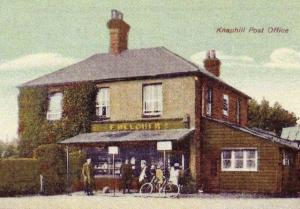
 Welcome to Memory Lane Knaphill, a special view of Knaphill’s history. Over the years the Residents’ Association have met many of Knaphill’s ‘senior citizens’. Based on their memories of the Knaphill of their youth, KRA put together a series of articles in our quarterly Newsletters called Memory Lane, Knaphill. These articles look at the history of Knaphill through the recollections of people who lived in the area during the last century.
1. Memories of the life in Knaphill in the early years of the last century – from 1912
When Alan Frost was born at home in Sunnyside Terrace in 1912, Knaphill was a rural village with fields and countryside all around, far fewer houses and a bustling village centre. Alan was the second to youngest of 13 children. They had ‘two and a half bedrooms’ (with the living room making space for extra beds at night), one tap with only cold water, no bathroom, (but a galvanized bath for use on ‘bath night’), an outside ‘privy’ but a good size garden where they grew vegetables throughout the year. Daily life was simple with none of the comforts we take for granted, but Alan remembered his Mother preparing chunks of bread and dripping for supper and the cosy warmth of their small house.
Sadly Alan’s father died when Alan was only four and a half years old. His father had been a postman, working from Belchers, which was the Post Office in Knaphill village (shown in the postcard above). Widow’s pensions were very small and ‘benefits’ non existent in those days, so the family and good neighbours had to rally round and help each other. Alan remembered his older brothers and sisters having to look after the little ones, so when he started school later that year he walked across the common to Knaphill Council School with his big sisters keeping a watchful eye on him.
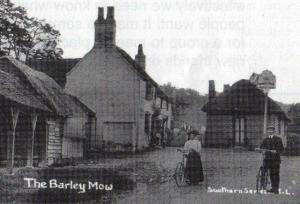 Alan had clear memories of his school days, the inkwells and straight nib pens, the daily arithmetic and times tables to be learnt and the strict discipline. Alan didn’t think he really liked school very much and as soon as he was able to he knew he wanted to earn some money to help at home. By the time he was ten he had an after school ‘job’ chopping wood for kindling, bringing in the coal and gardening for the Doctor at the Knaphill Surgery. Of the one shilling a week he earned most went to his mother, but one penny was for Alan to keep. He remembered that he usually spent it on creamy toffee from one of the many confectioners in the village.
In those days full time work usually started by the age of fourteen and Alan went out to find a job for himself by asking the local farmers if they had any work for a lad. He found a job at a small dairy and mixed farm in Pirbright, helping to milk the cows and then going round delivering the milk to the local houses. He learnt to drive a pony and trap, loaded with churns, and carefully ladled the fresh milk into a jug at each kitchen door on the morning milk round. He had to get up at 5.30 a.m. and walk to Pirbright ready to start at 7.00. He remembered his hob nail boots and frequently getting winter chill blains on his cold feet. Later on he saved up to get an old bicycle and that gave him an extra bit of time in bed and warmer toes!
After two years Alan went to work at ‘Grimditch & Webb Butchers’ on the High Street in Knaphill to learn a trade. In the 1920’s and 30’s when Alan started work there were about fifty shops in the centre of the village, with four butchers alone. There were also two slaughterhouses, so cattle, sheep and pigs were a common sight in ‘Mr. Moore’s’ yard at the back of the High Street. Alan explained that there was plenty of demand for fresh meat as shopping habits were different then; with no refrigerators in people’s homes, households would usually buy fresh food a ‘day at a time’.
Alan met and courted his wife May in Knaphill. Like many young girls at that time she had moved to the area to work in domestic service. They spent most of their married life in Highclere Road, living, working and bringing up their family in Knaphill and Alan stayed in the meat trade until he retired.
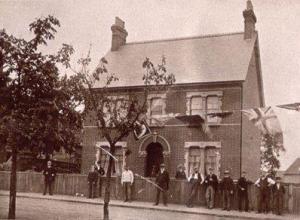 Mrs Marjorie Kingsbury (nee Harding b.1913) also remembered growing up in Knaphill, and spending many hours helping on the family farm. The farm house was ‘High Clere’ (illustrated to the left; where the pet shop is now), with agricultural land, stables, cowsheds and fields close to the centre of the village. There was no electricity when she was a young girl so what lighting there was came from paraffin lamps and gas lights.
Listening to Mrs Kingsbury’s vivid recollection of the layout of the village and the wide range of shops spread along the High Street and piecing together the images captured in postcards and photographs of those years it is easy to image that very different Knaphill of the years around the First World War and the early 1920’s.
There were several providers of grocery provisions, including the Co-operative Society, Wilsons, Means and ‘The International’. Grimditch & Webb and Moore’s were just two of the butchers shops, with Moore’s large slaughterhouse and yards at the back and livestock in pens awaiting their fate. There was a small dairy selling fresh milk, and Miss Mingay’s shop sold wet fish and fresh vegetables. The main bakers was Pickards, with ‘bake houses’ behind the shop, so there was sometimes a sweet smell of cakes and bread being baked to compete with some of the less pleasant smells of the farms and animals. (The Knaphill memories we hear are not of a ‘picture postcard’ village, it seems to have been a working centre, with ‘muck and manure’ to avoid stepping in when walking through the centre).
The village ironmongers were F.G. Rice’s. They had all manner of tools and garden implements, nails and nuts and bolts, (sold by weight) 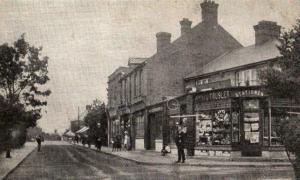 downstairs and china and glassware upstairs, plus a coal yard at the back. Most ladies made their own clothes and sewing was a valued skill so there were several suppliers of cloth and sewing items. Ruglys’ was one of the popular drapers and also had a newsagent. There were several gent’s outfitters (including Humphries) and for the ladies a number of dressmakers who made clothes to order, often working from home. Other shops included Harvey’s the pharmacists, Belchers which was the Post Office and stationers with a small telegraph office (to receive telegrams) inside and the sorting office attached to the side of the shop. Trotters was the cycle repair shop, where you could take the early ‘batteries’ for the old crystal sets once a week to be ‘recharged’. The cobblers and shoe shop was Mr Hill’s and Forcett’s had the rag-and-bone yard. There were also several churches and public houses at the top of the hill and out along the roads leaving the centre of the village; there seemed to have been almost everything a family would need within walking distance of home.
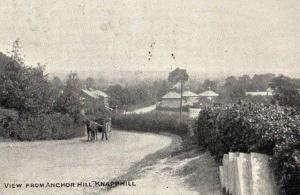 There were open spaces between the shops, with a few cottages, houses (some with small ‘shops’ in their front room), gardens, plots for vegetables, bee hives, orchards and then fields out to Chobham Road and down Anchor Hill (see the postcard to the right). Listening to Alan and to Mrs Kingsbury’s memories one builds up a picture of Knaphill as a thriving rural village with Woking and the wider world too far away to be of very much concern to those who grew up in the Knaphill of the 1920’s.
We have also met other residents who remember other aspects of village life……. Knaphill people have many wonderful stories to tell which can help us to understand the history of our ever-changing village….the sports clubs, churches, school days in Knaphill, the hey day of the Brookwood Hospital and much more……. We will tell you about them in future articles…….
Sadly in the years since the original preparation of this article in 2006, Alan Frost and Mrs Kingsbury have died. KRA were pleased to have been able to share some of their memories and to go on to share our notes of their memories with you.
 Some background information
 myKnaphill