Tag Archives: Brookwood Farm

Knaphill Planning Update – 12 February 2014

NEW PLANNING DECISIONS

PLAN/2013/0202 Total (now Esso) Garage, 23 High Street

Variation of condition 6 to PLAN/1985/0686

Currently the petrol station and associated shop have opening hours of 07.00 to 23.00 hrs. The application was to be allowed to open from 06.00 to midnight. In July the Planning Committee rejected this application but the owners lodged an appeal.

The Planning Inspector has permitted the extended opening hours for a trial period of 12 months.

PLAN/2013/0991 Alpha hospital, Rose Lodge, Barton Close

Alterations to PLAN/2012/0700

This application is to take account of the fact that the original plans that were approved had the construction traffic entering the site via Barton Close where after representation it was changed to direct entry from Redding Way.

Application approved.

PLAN/2013/1229

Variation to the conditions imposed on the new house built between 58 and 62 Chobham Road.

The planning application that was approved had no windows on the side of the house facing No 62. The developer went ahead and put three windows into this side of the house and then submitted a planning application for retrospective approval.

This retrospective application has been approved by the Head of Planning under delegated authority.

PLAN/2013/1081  Barnbrook Sinclair, 1 & 3 High Street, Knaphill

This is an application to gain outline planning permission to demolish the current building and build a four storey block of flats. There would be 10 flats four of which would be two bedroom flats but only 10 parking bays. This building, as well as the old headquarters of Barnbrook Sinclair, is also the home of the pet shop Pets Kingdom and PC repair A&E PC Repairs both of which will lose their premises if planning permission is granted.

The planning application has been rejected by the Local Planning Authority on the grounds that the  village could ill afford to lose the shops and office accommodation housed in the current building.

PLAN/2013/1122 & 1124 Tesco’s 15 High Street

Installation of an ATM to the shop front.

The installation of 6 bollards in front of the proposed ATM and shop front.

The above two planning applications are linked. Local residents have asked if another ATM in the village is required? If Tesco’s feel that it is important for the store to have its own ATM then residents want to see it relocated from the Fosters Lane end of the building.

Planning Committee approved the installation of an ATM at the Fosters Lane end of the building. The number of bollards was reduced to 4 and these will be located outside the store entrance. 

PLAN/2013/1225 15 High Street

Application to relax condition 24 of planning permission 2010/0085 to require that only the first and second floor windows in the west elevation be obscure glazed in perpetuity except windows 1 and 3 on the approved plan.

This is yet another planning application from the developer of the old Clifton’s site.  The condition in the original planning decision was added because the new building is very close to the houses in Fosters Lane and what then was HSBC bank. Woking Borough Council imposed a condition that the first and second floor windows in the east (facing the old HSBC bank) and west (facing Fosters Lane) shall be obscure glazed in perpetuity. The Council’s reason for this condition was to avoid overlooking into adjoining property.

The councillors on the Planning Committee unanimously rejected the application even though the Planning Officer recommended acceptance.  

PLAN/2013/1256 92 High Street

Erection of a two storey side and rear extension

Plans approved.

PLAN/2013/1222 35 Grindstone Crescent

Insertion of a second storey window

Plans approved.

NEW PLANNING APPLICATIONS & APPEALS

PLAN/2013/1114 New Haweli, 22 High Street

Application is to fit black tiles on the front of the take-away.

PLAN/2014/0021 Heathview, Grindstone Handle Corner

Build a second storey extension above existing first floor single storey extension. Convert existing garage into a habitable room and replace existing conservatory roof with a pitch tiled roof.

PLAN/2014/0067 41 Highclere Road

Demolition of existing dwelling and outbuilding and the erection of 3 detached houses with garages.

Note although the address is given as Highclere Road access to the new houses will be in Lane End Drive.

PLAN/2014/0081 Land at Brookwood Farm, Coresbrook Way

Application for new footpath and canal bridge to link new junior section of Brookwood Primary School and existing school.

In looking at the detail the footpath appears to have become footpath and cycle way.

AMEND/2014/0087 Tesco, 15 High Street

Variation of condition 2 to allow a 5 minute newspaper and magazine drop off.

Condition states no deliveries before 8.00am and after 8.00pm.

OUTSTANDING PLANNING APPLICATIONS

PLAN/2013/0350 48 Lower Guildford Road

Erection of a two bedroom detached house.

The original application was rejected under delegated powers. The grounds for the rejection were that the proposed development would result in an incongruous over development of the site in breach of CS21 and CS24 policies.

The applicant submitted an appeal on 12/12/2013.

PLAN/2013/0856 – Brookwood Farm

Reserved matters application for the access, appearance, landscaping, layout and scale for the erection of a primary school.

In December Woking Borough Council (WBC) Planning Committee deferred making a decision on the above application. One of the main reasons for deferment was due to the fact that Surrey County Council (SCC) had withdrawn a planning application for a new footpath and bridge connecting the two school buildings (more on this later in this report).  There was also concern with regards general access to the school both on foot and for vehicle access.  SCC had also failed to give any details on the materials to be used in the construction of the school and the Planning Officer stated in his report that if the materials are not carefully selected it could result in stark form of development within the landscape. Finally Councillors have issues with parking for parents dropping or collecting children.

Note:  The developer has added more details to the plans in line with the request from the Planning Committee.

PLAN/2013/0864 Brookwood Farm

New footpath and canal bridge.

This application is linked to the planning application, reported on above, for the building of a new school building on Green Belt land in Brookwood Farm. The footpath and bridge are to link the new school building to the school on Connaught Road. Surrey County Council plan for a new bridge to cross the canal, at the rear of the Connaught Road School and linked to a footpath that will go across the Country Park to the new school building on Brookwood Farm.

This application has been withdrawn by SCC. First, Natural England has raised a number of objections to the plan and secondly, local residents in Brookwood were opposed to the public footpath continuing through the school grounds and onto Connaught Road.

Note:  See new planning applications above.

PLAN/2013/0940 16 – 39 Chequer Tree Close

This application from the above residents is to change of use of open amenity land to become residential land by moving fence line.

PLAN/2013/1235 23 Sparvell Road

Erection of two storey rear extension

Brookwood Farm Development

The new road, Brookwood Farm Drive is now open and is the only vehicle access to Raynes Close.

Cala Homes have taken over the old Post Office in Connaught Road and converted it into an Information Centre for the proposed housing estate at Brookwood Farm. We understand that Cala Homes and Woking Borough Council are still negotiating the price of land currently owned by WBC.

Note This report does not attempt to cover all planning issues in Knaphill. If you have any questions or points on the above please feel free to contact the KRA.

Phil Stubbs

12/02/14
No improvement for traffic until after 2020?

At a meeting of Surrey County Councils Local Committee on the 06 March a paper was presented by Surrey Highways Authority on the congestion around the Brookwood Crossroads and adjoining roads. It is a pity that this debate was not held before the Planning Committee had to vote on the development on Brookwood Farm.

In presenting their paper SCC stated that as the major work programme from now until 2019 had been agreed they recommended that the congestion on the A322 should be considered as part of the review of major road schemes in 2015 for the post 2019 programme. This means that any major scheme designed to reduce the congestion on the Bagshot Road would not commence until 2020 at the earliest. This would be 3 years after the completion of all the new houses on Brookwood Farm and the opening of the new school.

The plan from SCC was vigorously challenged by the KRA, Brookwood Residents Association and the majority of Councillors who spoke during the debate. Cllr. J. Kingsbury put forward a suggestion that the in-depth study of the A322 and surrounding roads should start this spring. The study will take 18 months to complete and cost £50,000. Officers from Surrey Highways took the request away and will respond in the coming weeks.

One suggestion in the paper presented by Surrey Highways was that for short journey’s that is a journey of up 5 miles residents should consider walking or cycling rather than using a car. Phil Stubbs asked if this meant a parent living in Knaphill with a child attending the school in Bisley should walk or cycle the journey Knaphill/Bisley four times a day. Or the Brookwood resident from Brookwood going shopping at Sainsbury’s should take their bike rather than the car.

Brookwood Farm update

The majority of you will know that on the 29th January the Councillors who make up the Planning Committee approved the application from Cala Homes to build 297 dwellings on the land at Brookwood Farm. I came away from the meeting both angry and disappointed.

Angry because the Council Officers totally ignored those people who current live around Sparvell Road, Oak Tree Road and Coresbrook Way. It is these residents who will suffer the most from the increased traffic, its related noise and air pollution.

All the Councillors who spoke during the debate expressed reservations with the data included in the Planning Officers report on traffic levels. Although there was unanimity amongst the Councillors for a deferment once the Deputy Chief Executive, Head of Legal Services and Head of Planning applied verbal pressure on the Councillors not to vote for a deferment and accept the plan the majority caved in. All those Councillors not directly connected with Knaphill or Brookwood fell under the pressure and voted against a deferral and for the plan.

So yes disappointed with the fact that the Councillors did not stand by the views they expressed when they spoke for a deferment.

Why was so much pressure exerted on the Councillors? I believe there were two main reasons, first the Council have set themselves a target of 4,964 new dwellings between 2010 and 2027 (an annual average of 292 per annum). Secondly money, around two thirds of the land to be developed is owned by Woking Borough Council and that will now be sold to Cala Homes. That money will go to pay off a loan that the Council took out to pay for the work that was carried out in the Hoe Valley close to the Leisure Centre and Westfield Avenue.

Why were Councillors seeking a deferment? The Planning Officers report, the main document that is being debated and voted on, is only produced a week prior to the meeting and therefore there is not a lot of time to take on board all the detail that goes into a major development like Brookwood Farm. Let me put into context, in the past the Planning Committee deferred to a second meeting the applications to develop the Clifton’s site in the centre of the village and the extension to Sainsbury’s in Redding Way. Brookwood Farm is a much bigger development than either of the above and therefore why was the Deputy Chief Executive so opposed to the Councillors deferring a decision until they fully understood the proposal that the Planning Department and Surrey Highways were putting forward? That is a question for Woking Council to answer.

Unless a Councillor has been following the debate since the application was submitted last April then they rely on the Planning Officers report being accurate and objectively cover all aspects of the application. This report failed to achieve that objective.

For example The Planning Officers report states that there will only be a 33% increase in traffic levels going down Sparvell Road towards Bagshot Road between todays figure and the traffic levels once the development is completed. In words of the County’s Road Planning Manager an average of one additional vehicle per minute during peak times. Compare that with the figures in the Transport Assessment, a report produced by consultants as part of the preparation for the production of the Planning Officer’s report. The Transport Assessment shows an increase of 127% in the morning peak and 133% in the evening peak. The Councillors, and ourselves, wanted a deferment so that those differences could be investigated.

Another example of where the Planning Officers got it wrong. With reference to the length of the queuing traffic from the Brookwood traffic lights back up the Bagshot Road. The report states;-

‘The applicant’s Transport Assessment acknowledges that Bagshot Road is already heavily trafficked and that queuing develops, particularly at Brookwood Crossroad during peak hours to the extent that occasionally, southbound queue at the crossroads block the Redding Way signal.’

What a complete understatement, the queue is regularly beyond The Broadway never mind Redding Way.

There is a legal requirement that where a developer wants to build close to a heavily congested road they have to make recommendations on changes that will not significantly add to that congestion. In April 2012 I along with other representatives of local residents associations plus a number of Councillors met with Iain Reeve, Assistant Director Strategy, Transport & Planning and Greg Devine, Road Planning Manager both from Surrey County Council. We asked whether they believed the traffic management plan proposed by Cala Homes would somehow mean that the additional traffic would not add to the congestion. The response was that the proposed changes to the traffic light systems were unproven and that in their opinion would not meet the expectations of the developer. So what has changed between April 2012 and January 2013? As far as I know Cala Homes have not changed their proposed modification to the traffic lights systems. Maybe the KRA should invite Mr Reeve to another meeting so he can explain the change in the position of his department.

People have been asking where can we go from here. We the residents do not have the right of appeal. The only people who have the right of appeal to a decision made by the Planning Committee are those who submit the application. So if the Councillors on the Planning Committee had rejected Cala’s application Cala Homes could appeal and that would have gone to a Planning Inspector and probably a public inquiry. I cannot see how, following a public inquiry a Planning Inspector could have come up with a worse result than the one we got on the 29th.

This does not mean that the KRA will give up the fight, we have already asked Woking’s Head of Planning to explain the difference in figures for traffic in Sparvell Road.

We will keep you informed of any information that we are able to obtain.

The State of Planning

The plans for Brookwood Farm have been passed. Rightly or wrongly many residents feel abused by ‘the system’ and feel that the council has not performed their duties as well as they should have. This article is more of a collection of thoughts than a narrative of failings so any official reading through should not take overt offence but do feel free to leave comment.

Housing targets

We all know the government has set planning targets for each and every council in the land; these targets have to be met which requires new homes to be built. In the south east the demands are great – it’s a desireable place to live and housing costs are high but the landscape is pretty built up already. What green space there is is normally hard to get permission for building on and decent sized brownfield sites are hard to come by. People may disagree with the targets set both by government and borough councils but they are here to remain. There is a whole other argument as to the rationale behind the targets but that is for another time and place.

Where to build?

This is one of the key questions; the crux of the matter really. Building a huge number of homes piecemeal is not cost effective and will not make up the numbers adequately. To build in numbers you either build flats upwards or you build houses outwards and it’s the latter that really grabs the landscape. This is why whenever you see new proposals there are usually a number of flats thrown in – it sweetens the deal by making up numbers that the council need desperately.

So what of locations and where to build? Woking is simply short of them and that is why plans such as those for Brookwood are passed. There is no single place where a lot of houses can be built and not upset the residents, and I believe the residents understand, although maybe not agree with, that.

Soon to be up is Moor Lane and I guarantee a similar situation is occurring as we in Knaphill have experienced. A similar situation was shown on BBC’s ‘The Planners’ on 30th January – large swathes of land given over to developers.

Many people mention money in respect of these developments. It’s true that the councils will make money, or at least in the case of Brookwood Farm they will but not being an accountant I can’t comment on huge debt versus submitted plans.

Planning capability

Understanding of planning regulations and the local differences up and down the country is a thankless job. No-one loves a council planner but they deal with what they’re told to deal with and do so with what they’re told to use. Recently, Woking Borough Council were recruiting a proportionately large number of staff, to my mind something resembling the whole department in number. Whether this had any bearing on the Brookwood decision is anyone’s guess but it won’t have helped and the reasons for needing so many new planning office staff at once raised a few eyebrows.

The biggest wonder is exactly what the procedures the council follow actually state as the documents appear not to allow for any amount of community or residential response to be taken into account. WBCs housing strategy 2011-2016 has a couple of stated aims of creating a strong community spirit… and a clean, healthy and safe environment. The planning process abjectly fails to do this and seems to act against it.

How can the planning process help build community when the process itself does not engage with the community as a part of the plan? Speaking of my own experience of dealing with the Brookwood plans – from conception the developer had 3 meetings with the public (only 1 of 3 were widely publicised); at these there were no actual plans to discuss, only concepts. The staff were provided by the developer and had no understanding of the area, demographic or planning in general. In fact the most useful and knowledgable member there was the landscaper! From the point of plans being submitted (i.e. when the planning process kicked in) it was statements all the way from WBC; letters announcing plans had been receieved, amended and finally going to the committee. Documents found online did not appear to give the entire view and some key documents were witheld from the public prior to the committee meeting, ‘awaiting decomposition’. Although the last letter from WBC invited everyone to speak, in fact only ONE person is allowed to have their say (presumably on everyones behalf) for a maximum 3 minutes. Hardly enough time to cough and say hello. The point here is that there is no real intent at community engagement, only getting the plans through the process. Mentions of ‘community’ have been just that, mentions and nothing of substance.

With regard to Brookwood Farm, major concerns remain with regard to traffic, roads, school places and medical cover provision. Houses must be built, but the infrastructure supporting them must be an imperitive also and no-one can see where this has been met. Records from a few years ago stated the maximum number of houses supportable on the A322 was 200, not the 300 now passed by committee. A new school being built adds to the problems in several ways, firstly it doesn’t provide enough spaces for pupils but it also necessitated another entrance to the development and even more traffic movements. Figures stated were predicted. We went and did our own number checking by actually counting the traffic movements and the predicted numbers are way off.

Being practical

The point above is that a more practical approach is required. Using untested traffic models and saying ‘we must have the houses’ is not good enough. If communities are to be built, as the council purport to be adamant about, then effort is required and a little bit of legwork wouldn’t go amiss either. If a lot of people are practically shouting ‘there is a traffic problem!’ then the chances are that there is a traffic problem, it’s not a trick. Go and count some cars. Get cold, get hot and get stuck in the fumes but make damned sure your numbers are fact-based and not pie in the sky. If the number of cars don’t stack up then do something about it – reduce the number of dwellings or find another way of reducing traffic. Telling people to walk or get the bus is not one of these. The planners, the councillors and the council all know there are issues when large scale plans are up for debate but precious little is done to allay their fears.

300 new homes and a school are to be built, so what about medical cover? What’s it like at the moment? Over-burdened? Well perhaps some form of mitigation there would be in order then; make it a part of the plans (not a condition, an actual part of the plan).

What of other plans submitted? 15 High Street (with flats above) is a good one. Does a village require 3 supermarkets in close proximity? Like a hole in the head. Common sense (not part of the planning process) would suggest that 3 huge players (Sainsbury’s, Tesco and Co-Op) in the retailing game would put local traders out of business. It is not competition, it is the death of community. A look at the plans also show that deliveries can only happen if certain parking spaces are vacant which should, surely, have raised the question of ‘is this really the best idea?’. Incidentally refuse deliveries for that development will have to be made via the kerbside, another point for questioning the plans.

The Point

There is no benefit to examining in detail any plan. The point to be made here was that the planning process is just plain wrong, for starters there is no planning involved, it’s just going through the motions.

To councils up the land –  More community engagement would go a very long way with most people and be demonstrating just a bit of thought over what the plans are showing you. Thinking of the resultant activity and impacts will inevitably lead you to a better solution. Some might call this actual planning – deliberate thought over the impact of intended changes for the betterment of an area and community. Show that you value the area you have stewardship over and the people within it, and not that you are really just after the cash reward.

A simple request goes out to all of you planners – start to think about what you’re doing and stop ticking boxes.

Last thought

Last year the taxpayer footed the £50m bill for the West Coast Main Line franchise bid going pearshaped after Sir Richard Branson questioned it. He was in a unique position of wealth and influence to do so and by that factor alone unearthed what people have known for some time – the process was wrong. Where’s Branson when you need him?

Local History, Memory Lane – Knaphill

Welcome to Memory Lane Knaphill, a special view of Knaphill’s history. Over the years the Residents’ Association have met many of Knaphill’s ‘senior citizens’. Based on their memories of the Knaphill of their youth, KRA put together a series of articles in our quarterly Newsletters called Memory Lane, Knaphill. These articles look at the history of Knaphill through the recollections of people who lived in the area during the last century.

1. Memories of the life in Knaphill in the early years of the last century – from 1912

When Alan Frost was born at home in Sunnyside Terrace in 1912, Knaphill was a rural village with fields and countryside all around, far fewer houses and a bustling village centre. Alan was the second to youngest of 13 children. They had ‘two and a half bedrooms’ (with the living room making space for extra beds at night), one tap with only cold water, no bathroom, (but a galvanized bath for use on ‘bath night’), an outside ‘privy’ but a good size garden where they grew vegetables throughout the year. Daily life was simple with none of the comforts we take for granted, but Alan remembered his Mother preparing chunks of bread and dripping for supper and the cosy warmth of their small house.

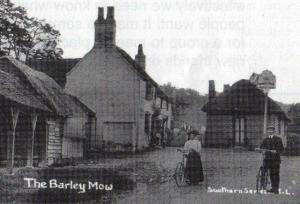
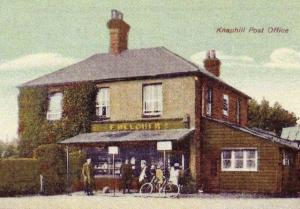
Sadly Alan’s father died when Alan was only four and a half years old. His father had been a postman, working from Belchers, which was the Post Office in Knaphill village (shown in the postcard above). Widow’s pensions were very small and ‘benefits’ non existent in those days, so the family and good neighbours had to rally round and help each other. Alan remembered his older brothers and sisters having to look after the little ones, so when he started school later that year he walked across the common to Knaphill Council School with his big sisters keeping a watchful eye on him.

Alan had clear memories of his school days, the inkwells and straight nib pens, the daily arithmetic and times tables to be learnt and the strict discipline. Alan didn’t think he really liked school very much and as soon as he was able to he knew he wanted to earn some money to help at home. By the time he was ten he had an after school ‘job’ chopping wood for kindling, bringing in the coal and gardening for the Doctor at the Knaphill Surgery. Of the one shilling a week he earned most went to his mother, but one penny was for Alan to keep. He remembered that he usually spent it on creamy toffee from one of the many confectioners in the village.

In those days full time work usually started by the age of fourteen and Alan went out to find a job for himself by asking the local farmers if they had any work for a lad. He found a job at a small dairy and mixed farm in Pirbright, helping to milk the cows and then going round delivering the milk to the local houses. He learnt to drive a pony and trap, loaded with churns, and carefully ladled the fresh milk into a jug at each kitchen door on the morning milk round. He had to get up at 5.30 a.m. and walk to Pirbright ready to start at 7.00. He remembered his hob nail boots and frequently getting winter chill blains on his cold feet. Later on he saved up to get an old bicycle and that gave him an extra bit of time in bed and warmer toes!

After two years Alan went to work at ‘Grimditch & Webb Butchers’ on the High Street in Knaphill to learn a trade. In the 1920’s and 30’s when Alan started work there were about fifty shops in the centre of the village, with four butchers alone. There were also two slaughterhouses, so cattle, sheep and pigs were a common sight in ‘Mr. Moore’s’ yard at the back of the High Street. Alan explained that there was plenty of demand for fresh meat as shopping habits were different then; with no refrigerators in people’s homes, households would usually buy fresh food a ‘day at a time’.

Alan met and courted his wife May in Knaphill. Like many young girls at that time she had moved to the area to work in domestic service. They spent most of their married life in Highclere Road, living, working and bringing up their family in Knaphill and Alan stayed in the meat trade until he retired.

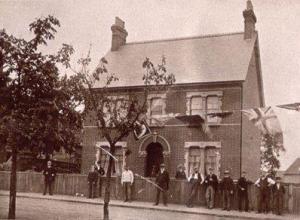
Mrs Marjorie Kingsbury (nee Harding b.1913) also remembered growing up in Knaphill, and spending many hours helping on the family farm. The farm house was ‘High Clere’ (illustrated to the left; where the pet shop is now), with agricultural land, stables, cowsheds and fields close to the centre of the village. There was no electricity when she was a young girl so what lighting there was came from paraffin lamps and gas lights.

Listening to Mrs Kingsbury’s vivid recollection of the layout of the village and the wide range of shops spread along the High Street and piecing together the images captured in postcards and photographs of those years it is easy to image that very different Knaphill of the years around the First World War and the early 1920’s.

There were several providers of grocery provisions, including the Co-operative Society, Wilsons, Means and ‘The International’. Grimditch & Webb and Moore’s were just two of the butchers shops,  with Moore’s large slaughterhouse and yards at the back and livestock in pens awaiting their fate. There was a small dairy selling fresh milk, and Miss Mingay’s shop sold wet fish and fresh vegetables. The main bakers was Pickards, with ‘bake houses’ behind the shop, so there was sometimes a sweet smell of cakes and bread being baked to compete with some of the less pleasant smells of  the farms and animals. (The Knaphill memories we hear are not of a ‘picture postcard’ village, it seems to have been a working centre, with ‘muck and manure’ to avoid stepping in when walking through the centre).

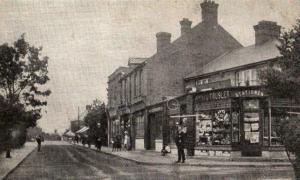
The village ironmongers were F.G. Rice’s. They had all manner of tools and garden implements, nails and nuts and bolts, (sold by weight) downstairs and china and glassware upstairs, plus a coal yard at the back. Most ladies made their own clothes and sewing was a valued skill so there were several suppliers of cloth and sewing items. Ruglys’ was one of the popular drapers and also had a newsagent. There were several gent’s outfitters (including Humphries) and for the ladies a number of dressmakers who made clothes to order, often working from home.  Other shops included Harvey’s the pharmacists, Belchers which was the Post Office and stationers with a small telegraph office (to receive telegrams) inside and the sorting office attached to the side of the shop. Trotters was the cycle repair shop, where you could take the early ‘batteries’ for the old crystal sets once a week to be ‘recharged’. The cobblers and shoe shop was Mr Hill’s and Forcett’s had the rag-and-bone yard.  There were also several churches and public houses at the top of the hill and out along the roads leaving the centre of the village; there seemed to have been almost everything a family would need within walking distance of home.

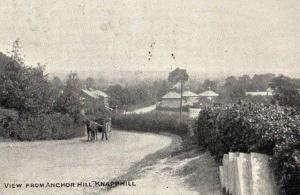
There were open spaces between the shops, with a few cottages, houses (some with small ‘shops’ in their front room), gardens, plots for vegetables, bee hives, orchards and then fields out to Chobham Road and down Anchor Hill (see the postcard to the right). Listening to Alan and to Mrs Kingsbury’s memories one builds up a picture of Knaphill as a thriving rural village with Woking and the wider world too far away to be of very much concern to those who grew up in the Knaphill of the 1920’s.

We have also met other residents who remember other aspects of village life……. Knaphill people have many wonderful stories to tell which can help us to understand the history of our ever-changing village….the sports clubs, churches, school days in Knaphill, the hey day of the Brookwood Hospital and much more……. We will tell you about them in future articles…….


Sadly in the years since the original preparation of this article in 2006, Alan Frost and Mrs Kingsbury have died. KRA were pleased to have been able to share some of their memories and to go on to share our notes of their memories with you.