Tag Archives: history

Memory Lane – Knaphill History, The Brookwood Hospital

When we look back over the history of Knaphill we find that the ‘Brookwood Hospital’ played a vital part in the development of the village. In the 1850’s local settlement was at the bottom of Anchor Hill, near the thriving nurseries, but the building of the ‘Brookwood Lunatic Asylum’  (completed in 1867) brought major changes.

The initial hospital population was 650 patients: 321 males and 329 females. It was built in 150 acres of land in an isolated part of the country as the trend at that time was to house those deemed to be ‘lunatics’ at a distance from ‘normal’ people. Over the next hundred and twenty years it was a major employer, recruiting doctors, nurses, ancillary staff, maintenance and support workers and the life of Knaphill flourished around it.

From the early days the hospital expanded and by 1903 the patient population had risen to 1,265. In 1919 the title ‘asylum’ was dropped and replaced by ‘Mental Hospital’. With so many patients and staff to care for them, Knaphill grew. The brick works were busy and so were the builders and developers. We can still see the many different styles of houses that were constructed for the growing population of the village. Shops of all kinds, public houses and churches thrived too, catering to the earthly and spiritual needs of the bustling community. At the time of The National Health Act in 1946, the hospital was the home for 1,900 patients.

For our Memory Lane articles in the Knaphill News we have spoken to many local people who still remember the hospital in its hay-day; and they have clear personal recollections of this aspect of our local history. Many local people worked at the hospital and have vivid memories  of the years when it was a major local employer and played a key role in the treatment of mental health in South Eastern England.

Marion Healy started her nursing career here in 1948 and stayed until 1990. Marion told KRA about her memories of the Hospital and changing attitudes to ‘Mental Health Care’ during the years that she worked there. Marion remembered Brookwood’s high standards of care and training, but also the locked wards, many geriatric patients and the T.B. Unit. As a Nursing Sister she saw how the gradual advances in medicine helped to bring patients’ symptoms under control by drugs. Change continued so that in 1974 the NHS was being reorganized again and it was decided to close all large mental hospitals and from 1986 a programme was underway for the closure of the Brookwood Hospital in 1994.

Marion’s recollections were of the tolerance of local people; of nurses from all over the world coming there to train there; of the range of social events that entertained patients, staff and locals and that made it a very happy place to live and work. For so many Knaphill residents the hospital was the source of employment. It attracting people from all over the county and many of them settled down and got married, had families and those families continue to live locally.

June Harding was born in Knaphill. Her parents met when working at the hospital and later married. “My father came here in the 1920’s and worked mainly in the high security unit. My mother left home in Wales aged seventeen to come to work there because her father was so strict.”

“The farm had cows, sheep, and shire horses and where the Vyne Car Park is now was the piggery. The hospital driveways were lined with beautiful rhododendron bushes, kept in immaculate condition, largely by patients working under supervision.” June recalled Christmas parties, annual coach outings to the seaside and Saturday Dances. “That was the highlight of my week as a teenager! And the highlight of the year for everyone was the August Bank Holiday Fete on the   main playing field. There were marquees exhibiting flowers, fruit and vegetables, handicrafts; side-shows, swinging boats and stalls. It was a wonderful event for everyone attracting people from miles around.”

Willi Jost came to work there in 1956 as a ‘drain man’, keeping the sewage etc clear. Over the years he was promoted and eventually came to be in charge of the staff restaurant. (Yes, an interesting career path!) Willi remembered Brookwood as a good place to work. Staff lived in the ‘hospital cottages’ on Oak Tree Road, Sparvell Road, The Spur; everyone lived locally and worked locally, people were good neighbours, all helping one another.
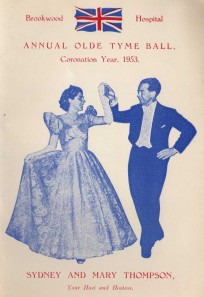
In the hospital there were workshops for boot-making, printing and all manner of repairs. Brookwood even had its own Fire Station and Willi worked as a Volunteer Fireman for extra income. The good social life was important to Willi too: the cinema shows, weekly dances (old time and modern), and Willi mentioned that quite a lot of ‘courting’ was done on those famous dance nights!

Since the hospital closed in 1994 the area has changed dramatically. The clock tower and the central building around it were converted into expensive apartments and named Florence Court (acknowledging the ‘Florence Wards’ originally named after Florence Nightingale); but most of the buildings were demolished, trees and flower beds etc removed. New houses were built, creating Redding Way, Percheron Drive, Barton Close, Florence Way, Tringham etc, again being given names that had links with the ‘Brookwood Hospital’. These are reminders that, for so much of its history, the life Knaphill was interwoven with the life of ‘the Hospital’.
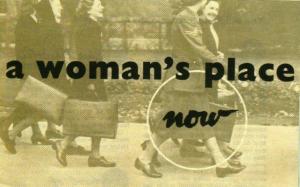
Knaphill History, Memory Lane – WOMEN at WAR

The history of Knaphill owes a great deal to the people who live here; to long established residents and some more recent arrivals.  KRA’s Memory Lane articles are based on the stories of real people who have made their home in Knaphill. When we were preparing the article ‘The Men and the Boys’, some of the wives overheard our conversations and they asked us to remember that wartime is not just about the exploits of the men! So we went back to record some of their wartime experiences; recollections of rationing, joining the Women’s Forces or doing ‘war work’, because the upheavals of 1939 – 45 were important for women too.

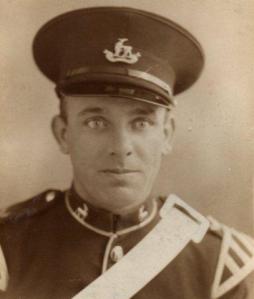
Josie Plant was born in Knaphill in 1937. “My dad, Joseph Plant, was a soldier, posted to Inkerman Barracks with The Royal Warwickshire Regiment. He met and fell in love with my Mum, Joan (Frost). Once War was declared he went off to fight, and was reported “missing” in 1940; I think we all thought we’d never see him again.  It was not until 1943 that Mum was notified he was being held as a prisoner of war by the Germans. On the day my Dad came home, my cousin Neil and I saw a chap coming down Anchor Hill, I didn’t know who he was; I didn’t know it was my Dad. Mum and the family put on a big party for him and made banners saying – ‘Welcome Home Joe’. He didn’t talk about it a lot, but we knew he’d had a terrible time at ‘Stalag XX1D’ prison camp.

I was only a kid, but I remember the ‘Doodle Bugs’ – bombs that would cut out and stop; some landed in Knaphill, the houses would shake. We often slept in the cupboard under the stairs (for ‘protection’ from the bombs) and later we had an ‘Anderson Shelter’ in the front room. It was like a big metal cage that you crawled under. In the first year after the war it was still there; we threw a cloth over it and used it like a table for my birthday party.”

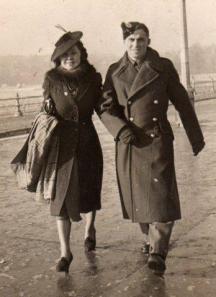
Grace Ludlow (nee Small) was born in 1918 and from the age of 5-12, by coincidence, lived in the very same house Josie was born in years later. Grace’s father was a well know local nurseryman, renowned for his roses. “I used to cycle down to our Village Hall for dances. I met my Joe when he was serving in the ‘Royal Welsh Fusiliers’ stationed at Blackdown Barracks. My Dad was none too pleased that I was being ‘courted’ by a soldier but I knew he was the one for me. We got married in 1939 and Joe was one of the first to leave for war. He had a gift for languages so he was seconded to ‘Intelligence’ and he didn’t get much home leave all through the war.

He was injured before Dunkirk and brought home on a ‘hospital ship’. Once he recovered he was sent to the Far East, down the Burma Road and he was briefly a Japanese prisoner of war, but managed to escape. Talking about it now you can hardly believe what the soldiers went through.

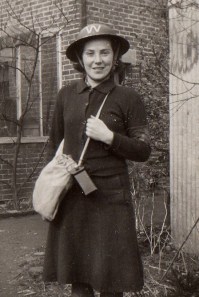
While Joe was away I moved back to live with my parents in West End,  and I worked at the bakery in St Johns, and in the evenings I was out in my tin hat as an ARP (Air Raid Precautions) Volunteer. I had to make sure everyone’s windows were ‘Blacked out’; so the bombers wouldn’t see us.

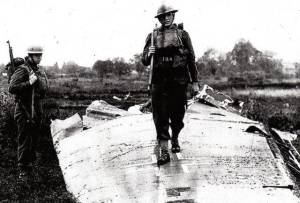
The siren at Brookwood Hospital often warned of attacks. Once a fighter plan crashed on the Recreation Ground at West End Village and my middle brother Alf found a machine gun in the wreckage. He brought it home, and sat with it propped it up on the kitchen table until Dad shouted – Get that back where you got it from!”

Patricia Norman was twenty-two when war started and was living in Bath, Somerset then. Pat worked as a civilian at the Admiralty. She had to sign the Official Secrets’ Act.  But despite the coded messages, teleprinter and a secret ‘phone, Pat said it was often boring.

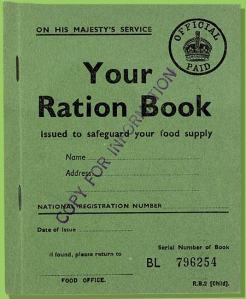
Bath’s historic buildings were bombed as part of Hitler’s “Spite Raids”, and a bomb dropped very close to Pat’s (less historic) home. She also remembered the long years of rationing. When a food parcel from Australia Pat and her mother were overjoyed to have dried egg powder, jelly crystals and tinned fruit; it was years before she could eat a fresh egg without feeling guilty!

Di Blair grew up in Mitcham. Aged fourteen, in 1938, she started full time work as a clerk at Conservative Central Office in Westminster. At that time Britain was not ready for war, so when Chamberlain (the Conservative Prime Minister) came back from Munich with ‘peace’ secured it was a great relief to the British public. Thousands sent him letters of gratitude and Di’s office had the job of acknowledging every one of them.War came, and for a while Di continued to work at Central Office. On one occasion Di actually spoke to Winston Churchill! She had to take an urgent message by hand and as Di approached he said “Is that for me my dear?”…..to which she calmly replied “Yes sir.”

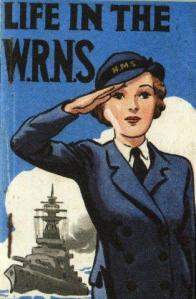
Di saw a poster – ‘Join the WRNS’. She join-up in June 1942, aged just 18. Initially as a ‘Wren’ within the Fleet Air Arm, but later as an ‘Air Mechanic – Ordnance’ (AM-O). She was taught how to strip down and repair all manner of small arms and ground defence weapons– rifles, Bren guns, Machine Guns. Most of the time she was based near Portsmouth; so it will be no surprise that she met and later married a sailor; she married Danny Blair, who features in one of our ‘The Men & the Boys’ articles.

Life was not easy for the girls who were at home. Soon after war started Joan Clark went to work in an aircraft factory, making parts for ‘Spitfires’. The bombs, time spent in the air raid shelters, the hardships, they were all part of everyday life and shortages meant Joan, like everyone else, had to adapt and cope. When Joan got married in 1941, she chose blue cloth for her wedding dress; it had to be ‘practical’, not just for one day!

Like other forces wives the early years of her married life were mostly spent apart from her husband. John was posted to Africa in 1943, when Joan was heavily pregnant. She was able to write and send photos, but it was nearly three years before he got home to see her again and to see their son for the first time. But as Joan said…..”at least I was one of the fortunate ones, my husband returned safely”.
……………………………………………………………………………………………………………………………………..
Thank you to everyone who has shared their memories with us for these articles.


KRA Memory Lane Series – The War Years in Knaphill 1939-45

As part of the KRA’s Memory Lane series in our Newsletters we have met many local residents and they have kindly shared with today’s readers their memories of Knaphill’s past. At this time of Remembrance we are putting a special series of Memory Lane articles on the website that recalled the wartime memories of many of today’s Knaphill residents: Part 1 of ‘The Men & the Boys’
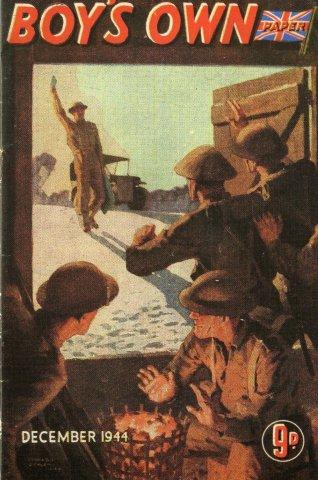
 

Derek Cloak has lived most of his life in Knaphill. He was just nine when the war started and has vivid memories of wartime life in and around Oak Tree Road. With Aldershot, Inkerman Barracks and many other military and strategic sites close by, Knaphill had its share of incidents to excite the imagination of schoolboys growing up in those war years.

Many London schools arranged for children to be evacuated out into the country and as many as five evacuees, plus Derek, his sister and Mum & Dad lived at their house.  Most of them were girls who were evacuated from Mayfield Girls’ School in Wimbledon. Derek’s Mother was a good organizer and the family always made the other children welcome. Many remained friends long after the war. Derek explained that for youngsters these were exciting times; they didn’t understand the risks and the dangers, they saw it as more of an adventure.

The A322 always seems to be busy now, but in the war years it was often busy with long convoys of Military Vehicles heading out along the Bagshot Road usually towards Bisley. Sometimes the trucks had to stop and the Mums from Oak Tree Road would make pots of tea to take to the troops while they waited.
Derek’s father was a Fire Warden and was on duty on several nights a week, with no street lights and the ‘black out’, and thankfully not too many major problems in Knaphill. But in 1940 many local people looked across from the top of Anchor Hill and could see the light of the fires blazing far away in London at the time of the Blitz.

War planes seemed to have been quite a common sight in the skies above Knaphill. One day the Mums were chatting and the children were playing in the front garden, when a couple of fighter planes flew low overhead engaged in a ‘dog fight’ and cartridges started falling all around. Derek remembered his Mother sending the children indoors and ushering them into the cupboard under the stairs….. for safety!! The British Spitfire plane was shot down. The pilot bailed out and came down near to Guildford, but the plane crashed on Inkerman Barracks in St Johns, killing several Canadian soldiers stationed there.

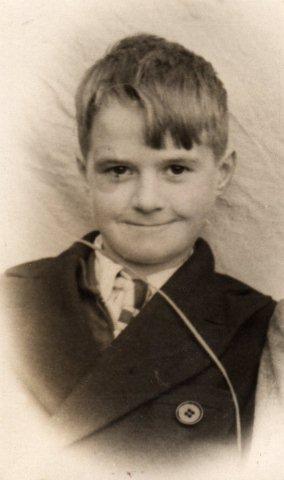
One Saturday afternoon when Derek and his mates were at ‘the pictures’ at the Brookwood Hospital Social Centre they heard a plane in trouble overhead. The excited youngsters ran to see what was happening. It was a twin crew Mosquito and it crashed along the Lower Guildford Road; both of the crew were killed.  That day Eric Fagence was at a football match on the Brookwood Farm playing fields and he remembered the same incident. Eric also recalled one of the German Luftwaffe Heinkels that crashed near to West End/Chobham. He went on the bus to see the wreckage, but left his gas mask up there and was sent back to retrieve it! Gas masks were compulsory, and had to be carried at all times. The photograph shows Derek aged about 8 or 9 in about 1940 and apparently the cord across his coat is tied to his gas mask.
In another incident a German Bomber was over Knaphill in daylight with British planes chasing it. The children were in school but could hear the bomber jettisoning its load nearby, and local Mothers ran up to the village fearing Knaphill School had been hit. The school was missed, but a house was flattened off the Bagshot Road and apparently thirteen more bombs were dropped over Brookwood Cemetery.

The war raged in Europe, but for the young boys like Derek and Eric at home much of life went on as normal and it seemed to be an exciting time. They had vivid memories of wartime Knaphill and we appreciate their sharing these recollections with us.

Local History, Memory Lane – Knaphill

Welcome to Memory Lane Knaphill, a special view of Knaphill’s history. Over the years the Residents’ Association have met many of Knaphill’s ‘senior citizens’. Based on their memories of the Knaphill of their youth, KRA put together a series of articles in our quarterly Newsletters called Memory Lane, Knaphill. These articles look at the history of Knaphill through the recollections of people who lived in the area during the last century.

1. Memories of the life in Knaphill in the early years of the last century – from 1912

When Alan Frost was born at home in Sunnyside Terrace in 1912, Knaphill was a rural village with fields and countryside all around, far fewer houses and a bustling village centre. Alan was the second to youngest of 13 children. They had ‘two and a half bedrooms’ (with the living room making space for extra beds at night), one tap with only cold water, no bathroom, (but a galvanized bath for use on ‘bath night’), an outside ‘privy’ but a good size garden where they grew vegetables throughout the year. Daily life was simple with none of the comforts we take for granted, but Alan remembered his Mother preparing chunks of bread and dripping for supper and the cosy warmth of their small house.

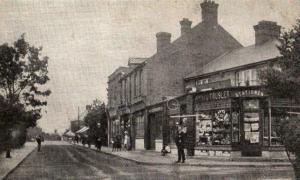
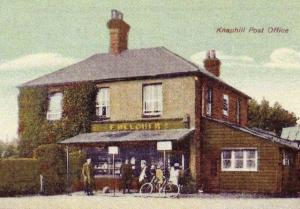
Sadly Alan’s father died when Alan was only four and a half years old. His father had been a postman, working from Belchers, which was the Post Office in Knaphill village (shown in the postcard above). Widow’s pensions were very small and ‘benefits’ non existent in those days, so the family and good neighbours had to rally round and help each other. Alan remembered his older brothers and sisters having to look after the little ones, so when he started school later that year he walked across the common to Knaphill Council School with his big sisters keeping a watchful eye on him.

Alan had clear memories of his school days, the inkwells and straight nib pens, the daily arithmetic and times tables to be learnt and the strict discipline. Alan didn’t think he really liked school very much and as soon as he was able to he knew he wanted to earn some money to help at home. By the time he was ten he had an after school ‘job’ chopping wood for kindling, bringing in the coal and gardening for the Doctor at the Knaphill Surgery. Of the one shilling a week he earned most went to his mother, but one penny was for Alan to keep. He remembered that he usually spent it on creamy toffee from one of the many confectioners in the village.

In those days full time work usually started by the age of fourteen and Alan went out to find a job for himself by asking the local farmers if they had any work for a lad. He found a job at a small dairy and mixed farm in Pirbright, helping to milk the cows and then going round delivering the milk to the local houses. He learnt to drive a pony and trap, loaded with churns, and carefully ladled the fresh milk into a jug at each kitchen door on the morning milk round. He had to get up at 5.30 a.m. and walk to Pirbright ready to start at 7.00. He remembered his hob nail boots and frequently getting winter chill blains on his cold feet. Later on he saved up to get an old bicycle and that gave him an extra bit of time in bed and warmer toes!

After two years Alan went to work at ‘Grimditch & Webb Butchers’ on the High Street in Knaphill to learn a trade. In the 1920’s and 30’s when Alan started work there were about fifty shops in the centre of the village, with four butchers alone. There were also two slaughterhouses, so cattle, sheep and pigs were a common sight in ‘Mr. Moore’s’ yard at the back of the High Street. Alan explained that there was plenty of demand for fresh meat as shopping habits were different then; with no refrigerators in people’s homes, households would usually buy fresh food a ‘day at a time’.

Alan met and courted his wife May in Knaphill. Like many young girls at that time she had moved to the area to work in domestic service. They spent most of their married life in Highclere Road, living, working and bringing up their family in Knaphill and Alan stayed in the meat trade until he retired.

Mrs Marjorie Kingsbury (nee Harding b.1913) also remembered growing up in Knaphill, and spending many hours helping on the family farm. The farm house was ‘High Clere’ (illustrated to the left; where the pet shop is now), with agricultural land, stables, cowsheds and fields close to the centre of the village. There was no electricity when she was a young girl so what lighting there was came from paraffin lamps and gas lights.

Listening to Mrs Kingsbury’s vivid recollection of the layout of the village and the wide range of shops spread along the High Street and piecing together the images captured in postcards and photographs of those years it is easy to image that very different Knaphill of the years around the First World War and the early 1920’s.

There were several providers of grocery provisions, including the Co-operative Society, Wilsons, Means and ‘The International’. Grimditch & Webb and Moore’s were just two of the butchers shops,  with Moore’s large slaughterhouse and yards at the back and livestock in pens awaiting their fate. There was a small dairy selling fresh milk, and Miss Mingay’s shop sold wet fish and fresh vegetables. The main bakers was Pickards, with ‘bake houses’ behind the shop, so there was sometimes a sweet smell of cakes and bread being baked to compete with some of the less pleasant smells of  the farms and animals. (The Knaphill memories we hear are not of a ‘picture postcard’ village, it seems to have been a working centre, with ‘muck and manure’ to avoid stepping in when walking through the centre).

The village ironmongers were F.G. Rice’s. They had all manner of tools and garden implements, nails and nuts and bolts, (sold by weight) downstairs and china and glassware upstairs, plus a coal yard at the back. Most ladies made their own clothes and sewing was a valued skill so there were several suppliers of cloth and sewing items. Ruglys’ was one of the popular drapers and also had a newsagent. There were several gent’s outfitters (including Humphries) and for the ladies a number of dressmakers who made clothes to order, often working from home.  Other shops included Harvey’s the pharmacists, Belchers which was the Post Office and stationers with a small telegraph office (to receive telegrams) inside and the sorting office attached to the side of the shop. Trotters was the cycle repair shop, where you could take the early ‘batteries’ for the old crystal sets once a week to be ‘recharged’. The cobblers and shoe shop was Mr Hill’s and Forcett’s had the rag-and-bone yard.  There were also several churches and public houses at the top of the hill and out along the roads leaving the centre of the village; there seemed to have been almost everything a family would need within walking distance of home.

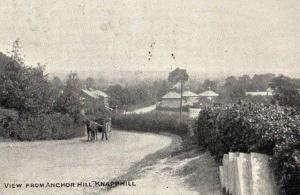
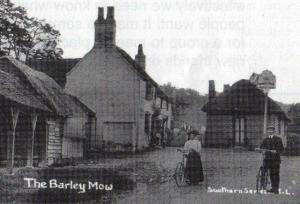
There were open spaces between the shops, with a few cottages, houses (some with small ‘shops’ in their front room), gardens, plots for vegetables, bee hives, orchards and then fields out to Chobham Road and down Anchor Hill (see the postcard to the right). Listening to Alan and to Mrs Kingsbury’s memories one builds up a picture of Knaphill as a thriving rural village with Woking and the wider world too far away to be of very much concern to those who grew up in the Knaphill of the 1920’s.

We have also met other residents who remember other aspects of village life……. Knaphill people have many wonderful stories to tell which can help us to understand the history of our ever-changing village….the sports clubs, churches, school days in Knaphill, the hey day of the Brookwood Hospital and much more……. We will tell you about them in future articles…….


Sadly in the years since the original preparation of this article in 2006, Alan Frost and Mrs Kingsbury have died. KRA were pleased to have been able to share some of their memories and to go on to share our notes of their memories with you.